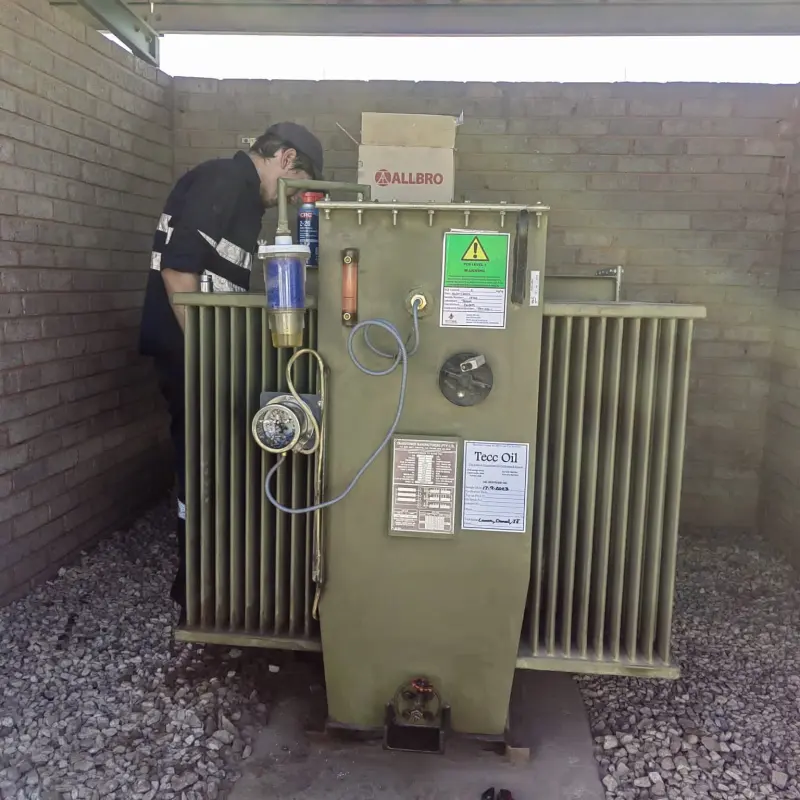
Why test transformer oil?
Insulating oil does two jobs: it insulates the windings and it carries heat away from them. Over time it picks up moisture, oxidises, and absorbs gases produced by electrical and thermal stress inside the tank.
That makes the oil a running record of the transformer's health. Regular testing shows developing faults months before they become failures, while there's still time to plan an outage rather than suffer one. For the cost, it's the most effective maintenance a transformer can get.
What we test for
A routine suite covers the oil's condition and the transformer's internal health. All analysis is done by SANAS-accredited laboratories to recognised international methods.
| Test | Method | What it tells you |
|---|---|---|
| Dissolved gas analysis (DGA) | ASTM D3612 | Gases dissolved in the oil reveal arcing, overheating and partial discharge. Interpreted to IEC 60599. |
| Moisture content | ASTM D6304 | Water in the oil lowers dielectric strength and ages the paper insulation faster. |
| Dielectric strength | IEC 60156 | The voltage the oil withstands before breaking down: a direct measure of insulating ability. |
| Acidity | IEC 62021 | Oxidation by-products that form sludge and attack the paper insulation. |
| PCB content | IEC 61619 | Whether the oil is contaminated with PCBs, for compliance and safe handling. |
| Furanic compounds | IEC 61198 | Chemical markers of paper ageing, an indicator of remaining insulation life. |
| Colour & appearance | Visual | Darkening, cloudiness or sediment: a quick early warning of contamination. |
How our oil analysis service works
- Plan the round. We build or update your transformer register: location, rating, nameplate data and previous results.
- Sample correctly. Samples are drawn from the drain or sampling valve into clean, dry containers, with oil temperature and conditions recorded. Poor sampling is the most common cause of misleading results, so we take it seriously.
- Laboratory analysis. Samples go to a SANAS-accredited laboratory with full traceability from transformer to report.
- Interpretation. We read results against IEC 60422 guidance and IEC 60599 for DGA, and compare them with previous results where available. Trends often matter more than a single number.
- Report and work schedule. You get a per-unit summary and a prioritised schedule: what needs doing, why, and how urgently.
- Label and record. Each unit is labelled with its sample date, lab report number and technician, so anyone on site can see its status.
Reading the results: a real example
On a 1 800 kVA, 11 kV / 400 V unit, the laboratory measured a dielectric strength of 53.3 kV (limit: above 50 kV) and moisture of 21.2 mg/kg (limit: below 20 mg/kg).
What it means: the oil still insulates adequately, but it's wet, and the margin is shrinking. Left alone, moisture will keep lowering dielectric strength and ageing the paper. The right response is to dry the oil with on-site purification, find and fix the moisture source (often a saturated breather or a leaking gasket), and re-sample to confirm.
Dissolved gas analysis, explained
When oil and paper are stressed by heat or electrical discharge, they break down into characteristic gases. Which gases appear, and in what ratios, points to the type of fault:
- Hydrogen: partial discharge (corona) in the oil or insulation.
- Methane, ethane and ethylene: thermal faults in the oil, from hot spots and poor connections to severe overheating.
- Acetylene: high-energy arcing. Even small amounts warrant prompt attention.
- Carbon monoxide and carbon dioxide: overheating of the paper (cellulose) insulation.
We look at gas levels, ratios and rates of change together. Where DGA points to a problem, we follow up with electrical tests to pinpoint it.
PCB testing and labelling
Some older transformers contain oil contaminated with polychlorinated biphenyls (PCBs). South African regulations require PCB-containing equipment to be identified, labelled and managed. We test for PCB content and label each unit with its result, giving you a clear compliance record.